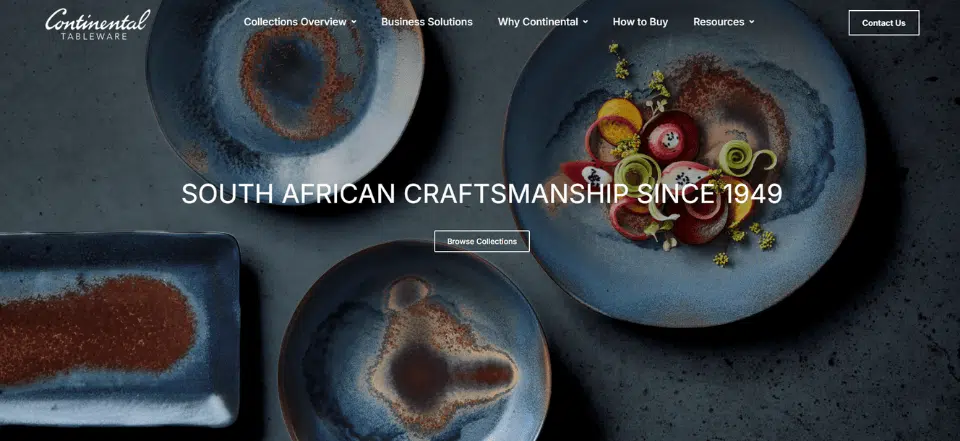
For more than 75 years, Continental Tableware has played a pivotal role in shaping South Africa’s hospitality industry. With deep roots in tradition and a forward-looking approach to innovation, the brand has grown from modest beginnings into a trusted partner for restaurants, hotels, and establishments nationwide. Its legacy is built on a foundation of craftsmanship, resilience, and a steadfast commitment to quality, reflecting a proud heritage that continues to inspire its evolution.
RubyWeb was tasked with building an engaging, modern website that would serve as the foundation for a future e-commerce platform. Key goals included increasing brand visibility, showcasing product quality, and building trust with a new consumer audience through an elevated digital presence and organic content strategies.
Continental Tableware (formerly Continental China) sought to reposition itself as a proudly South African consumer brand while transitioning from its long-standing B2B identity. The primary objective of Phase 1 was to build an engaging, modern website that would serve as the foundation for a future e-commerce platform. Key goals included increasing brand visibility, showcasing product quality, and building trust with a new consumer audience through an elevated digital presence.
The brand’s historical presence was fragmented across multiple domains (continentalchina.co.za and continentalonline.co.za), which required a carefully planned migration to unify content and functionality under a single platform. This consolidation meant reworking the site’s structure and presentation to support the client’s transition from B2B to B2C, ensuring that the design, navigation, and content layout were tailored for a consumer‑focused experience. The project timeline experienced minor delays due to challenges in accessing required imagery, securing plugin approvals, and obtaining staging credentials. Despite these hurdles, Phase 1 successfully delivered a polished public‑facing website while laying the technical groundwork for more complex Phase 2 integrations.
The project centered on designing and developing a user‑friendly website that reflected the brand’s new identity. This involved creating a clear structure for 21 product categories, ensuring intuitive navigation, and planning redirects from the old domains to unify the brand’s online presence. The site was also architected to support future e‑commerce functionality, with scalability and flexibility built into its framework. Technical improvements were implemented to enhance performance, reliability, and overall user experience. All efforts were coordinated through a central project manager and executed by a skilled full‑stack development team, ensuring a smooth and effective delivery process.
A clean, professional brochure‑style website was developed within the existing WordPress and WooCommerce framework, designed to present the brand effectively while ensuring scalability for future growth. The build was structured to support a seamless transition to e‑commerce in Phase 2, with careful attention to technical foundations and flexibility. User experience was enhanced through mobile responsiveness, POPIA compliance, and thoughtful content optimisation, resulting in a polished and reliable platform that reflects the brand’s identity and prepares it for ongoing digital expansion.